
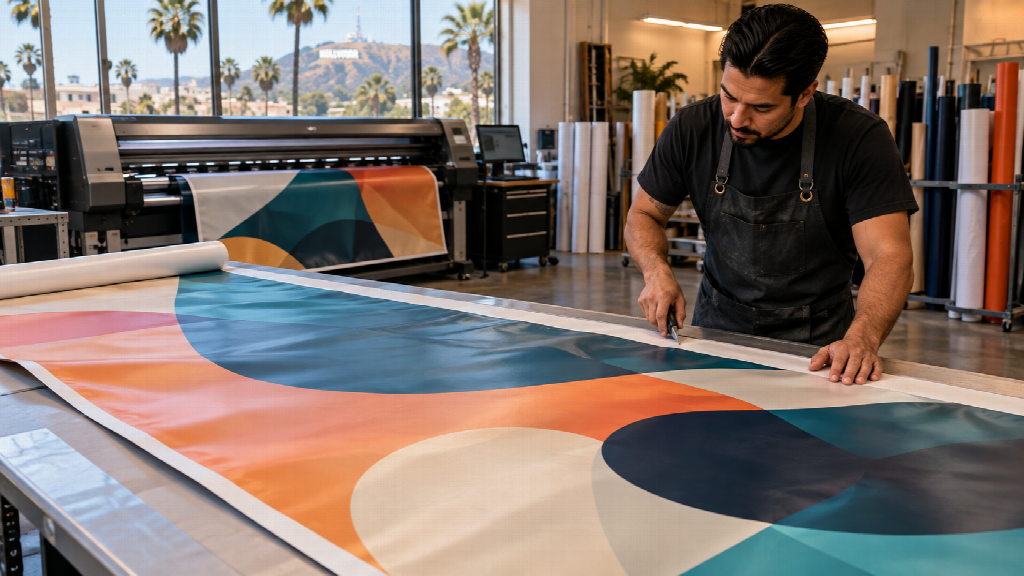
A banner has a simple job: deliver the right message to people passing through a space. Doing that well takes more planning than placing a logo on a large rectangle. Size, viewing distance, lighting, material, and installation all affect whether anyone can read it.
For businesses and event teams ordering custom banners in Hollywood, the deadline can matter as much as the design. A storefront promotion, production event, or opening night often has a fixed date. Getting the details right before printing saves time when the banner needs to be ready for that moment.
Start With Where the Banner Will Go
The first question to answer is where people will see the banner. A sign behind a registration table has a different purpose from one mounted outside a venue. One may appear in close-up photos, while the other needs to be readable from across the street.
Measure the available space and confirm how you can hang or support the banner. If you are using a venue, ask about its rules before you order. Some locations restrict where you can attach graphics or require specific installation methods.
Tell your printer whether the banner will be used indoors or outdoors, how long it needs to stay up, and whether you plan to reuse it. Those details help determine an appropriate material and finish.
Keep the Message Easy to Read
A banner is usually seen for only a few seconds. Give viewers one main thing to notice, such as an event name, a sale, or a direction to an entrance. Supporting information should earn its place.
As you review the design, ask:
- What should someone understand at a glance?
- How far away will the viewer be?
- Will people walking or driving past see the banner?
- Is the contrast strong enough in the site lighting?
- Could essential text be blocked by furniture, guests, or equipment?
If the banner includes a date, time, or address, have someone outside the project check every detail. A proof can look polished while still containing an old event date or the wrong venue address.
Choose a Material for the Setting
No single banner material suits every job. Vinyl is a common option for many event and business applications. Fabric may appeal to teams that want a different look for an indoor display. Other materials or finishing options may be appropriate depending on the installation.
Explain the setting to your print provider instead of choosing a material based only on a photo. An outdoor banner may face wind and sun. An indoor banner used as a photo backdrop needs to look good under the event’s lighting. A display that travels between venues must also be practical to pack and set up.
Ask about finishing and mounting at the same time. Treat the banner and its installation plan as one project.
Check the Artwork Before Production
Artwork that looks sharp on a phone screen may not hold up when enlarged. Send the printer the highest quality files available, and ask for its preferred file format and specifications.
Pay particular attention to photographs, small text, and fine lines. If you have brand colors to match, share the relevant specifications and ask what is achievable with the chosen material and print process. Colors can look different on a screen than in a finished print.
Before approving the proof, review it at two levels. Look at the full design to see whether the message is clear, then zoom in to check spelling, image quality, spacing, and any information that must be exact.
Build the Timeline Around the Event Date
If the banner is needed for a Hollywood premiere, pop-up, trade show, or grand opening, begin with the date it must be in your hands. Then work backward through artwork preparation, proof approval, production, and delivery or pickup.
Ask what turnaround is available for the size, material, and quantity you need. Rush service may be possible for some projects, but the answer depends on the final specifications and production schedule. If several people must approve the artwork, agree on one person who can provide a clear final sign-off.
Leave time for installation, too. A finished banner does little good if the team first discovers at the venue that it needs a different hanging method.
Work With a Printer Who Understands the Whole Project
The most useful print conversation covers more than dimensions and price. A good provider will ask how the banner will be viewed, what the site permits, when it is needed, and whether it must coordinate with other graphics.
For teams looking for custom banners in Hollywood, MM Hollywood offers graphics and signage services alongside design and print production. Its team works with local businesses, artists, entertainment productions, and event managers from its Sunset Boulevard location.
Share the location, approximate size, intended use, artwork status, and deadline when you request a quote. Those details give the printer a practical starting point for recommending an approach.
A successful banner looks good where it’s meant to be. Plan for the real setting, keep the message focused, and settle the production details before the deadline. The result will be easier to install and easier for your audience to understand.
Frequently Asked Questions
What size should a custom banner be?
Size depends on the available space and how far away people will be when they read it. Measure the installation area and tell your printer where viewers will stand or pass by before finalizing dimensions.
What information belongs on an event banner?
Lead with the event name or main message. Add only the supporting details people need in that location. A directional banner, for example, may need an arrow more than a long description.
How soon should I order a banner for an event?
Order as soon as you confirm the message, dimensions, and venue requirements. Ask the printer for a production timeline based on your specific material, finishing, quantity, and artwork.
Can I use the same banner indoors and outdoors?
Possibly, but the material, mounting method, and expected weather exposure matter. Tell your printer about both settings before ordering so it can advise whether one banner will suit them.
