
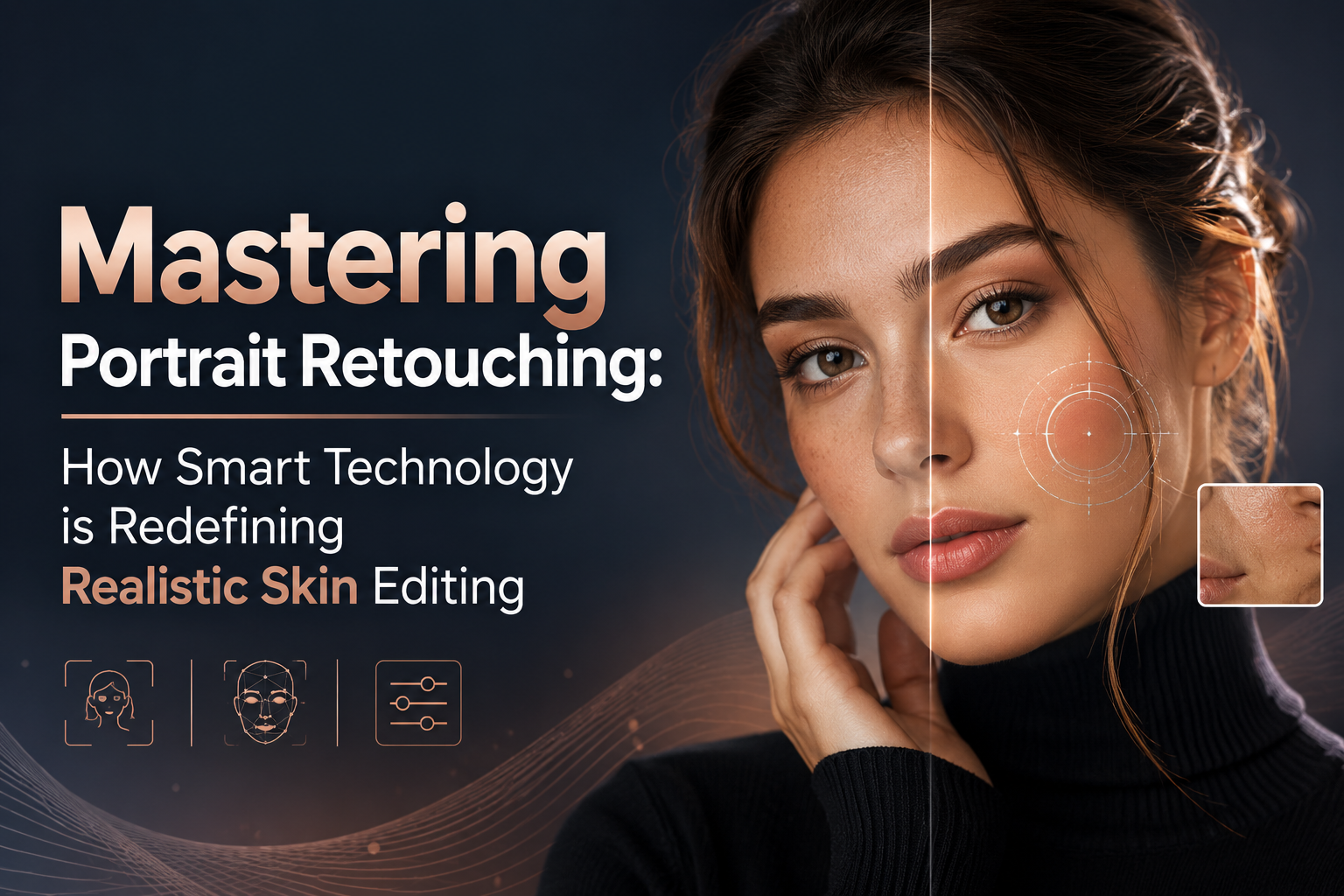
The era of plastic, heavily airbrushed skin is officially behind us. Viewers today intuitively recognize when faces look too perfect, rejecting over-processed images that create a psychological disconnect between the subject and the audience. The standard for portrait editing has shifted dramatically toward raw authenticity. People want to see rested, vibrant faces that retain their real human texture—including pores, minor freckles, and natural facial asymmetry.
Achieving this delicate balance between enhancement and realism used to require hours of meticulous manual brushing. Now, rapid advancements in neural networks and machine learning have completely transformed how creators handle skin optimization, making professional-grade results accessible to everyone.
The Evolution Beyond Manual Brushing
For years, photographers relied on highly complex, manual techniques like frequency separation to manage skin tones. This method involved splitting an image into distinct texture and color layers, allowing editors to smooth out blotchiness without completely destroying the skin’s grain. While effective in the hands of a master, doing this manually across hundreds of images was exhausting. If pushed even slightly too far, it resulted in a flattened, artificial mask.
Recent industry data reveals just how much tastes have changed. A staggering 68% of social media users now actively prefer natural-looking editing over heavy frequency separation. They want images that look like they were captured in incredibly flattering light, rather than rebuilt pixel-by-pixel inside a software interface.
This push for realism means editors must navigate micro-adjustments with extreme care. Instead of blasting away all contrast, the new focus is on preserving the subtle contouring that makes a person recognizable. Modern retouching separates permanent, character-defining features like beauty marks and distinctive smile lines—from temporary distractions like a sudden blemish or harsh undereye shadows caused by a bad night of sleep.
How Deep Learning Understands Facial Anatomy
Artificial intelligence approaches portrait editing through deep pattern recognition, trained on millions of diverse images. These algorithms do not just apply a generic, heavy-handed blur filter across the entire frame. Instead, they identify specific facial landmarks, understanding exactly how light interacts with different skin types, ethnicities, and ages.
This multi-scale analysis allows the software to examine the subject at a near-cellular level. It recognizes that the delicate, thin skin around the eyes requires a drastically different approach than the texture on the forehead or the color saturation of the lips. By mapping the face dimensionally, smart tools can execute targeted improvements without homogenizing the image. The neural networks are now sophisticated enough to fix a stray hair while keeping the fine peach fuzz that makes skin look tangible and real.
Precision and Simplicity in Everyday Editing
For everyday creators, influencers, and busy photographers, this technological leap means you no longer need an extensive background in graphic design to produce high-end portraits. Intelligent, web-based platforms handle the heavy lifting automatically behind the scenes.
When you need to clean up a headshot or refine a casual selfie, the process is incredibly streamlined. If you want to soften harsh lighting, reduce midday shine, or gently remove wrinkles from photo, modern algorithms blend the edits seamlessly into the surrounding pixels. The underlying texture stays completely intact. Your final image still looks like a photograph rather than a digital painting. You get to maintain full creative control, using simple sliders to dictate exactly how much enhancement is applied to the subject.
Navigating the Uncanny Valley
The “uncanny valley” effect occurs when a face looks almost human but just perfect enough to trigger a sense of visual unease. Viewers instinctively know when a face appears too smooth or too uniformly lit.
To avoid this trap, always retain some natural shadows under the eyes and along the jawline. Completely removing eye bags removes the three-dimensional shape of the face, making the eyes appear flat and unnatural.
Similarly, treat the natural aging process with respect. The objective of editing a mature subject is not to erase 30 years of life experience, but rather to present them looking their absolute best. Focus on evening out the overall skin tone, reducing temporary redness, and pulling back the deepest, darkest shadows in creases. Blurring facial lines away entirely strips the portrait of its personality and emotional weight.
Scaling Your Creative Workflow
The adoption of intelligent software in photography is accelerating at a breakneck pace, with the global market projected to reach $1.2 billion by 2026. This massive growth is driven directly by the need for speed, consistency, and volume. Spending half of your workday cloning out dust spots, stray hairs, and minor blemishes is no longer a viable way to operate.
By integrating smart automation into your daily pipeline, you shift your role from a manual pixel-pusher to a true creative director. You set the aesthetic vision, manage the lighting, and curate the best shots, while the software executes the mechanical, repetitive tasks. This is especially critical for professionals handling corporate headshots or wedding photography, where maintaining lighting and color consistency across hundreds of images is paramount.
Frequently Asked Questions
How does smart software identify what to edit on a face?
Neural networks analyze images using complex pattern recognition built from millions of training examples. They identify specific facial landmarks such as the eyes, nose, mouth, and jawline to map the face dimensionally. This allows the software to distinguish between a temporary blemish that should be removed and a permanent mole or subtle skin texture that should be preserved.
Why do heavily edited photos sometimes look unsettling?
This phenomenon is known as the uncanny valley effect. Viewers instinctively recognize when a face appears too flawless, too smooth, or uniformly lit. Over-processed images lack the natural texture, ambient shadows, and slight physical asymmetries that characterize authentic human faces, which creates a psychological disconnect and undermines trust.
Can automated editing handle high-volume photo shoots?
Yes, modern platforms are specifically designed to scale effortlessly. For high-volume projects like weddings or corporate headshots, smart software can batch-process entire folders by detecting individual faces and applying custom adjustments instantly. This automation eliminates hours of repetitive manual cleanup, maintaining strict consistency across hundreds of photos without requiring constant manual brushwork.
Should I completely remove all facial lines during retouching?
The current industry trend strongly favors natural optimization over heavy alteration. Instead of erasing all signs of aging, experts recommend slightly reducing the harsh shadows within deep creases while leaving the actual structural lines intact. This approach ensures the subject looks vibrant and well-rested while preserving the distinct, character-defining features that make their face entirely unique.
The Future of Authentic Portraits
Technology has finally caught up with our deep desire for authentic representation. We have officially moved past the era where heavy manipulation was the only way to achieve a clean, professional finish. Today’s intelligent systems empower anyone to elevate their portraits quickly while fiercely protecting the unique characteristics that make every face distinct. Embracing these tools allows you to work faster, experiment freely, and ultimately deliver images that resonate with viewers on a genuine, human level.
