
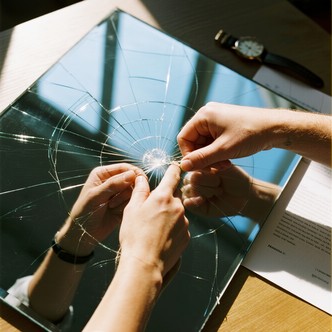
The windows go in early. Everything else happens around them: framing, grinding, rendering, painting, cleaning. Then the scaffold comes down, someone washes the glazing for the first time, and the marks that appeared over six months turn out not to wash off.
Replacing a single pane of architectural glass costs more than protecting every opening on the job would have. That arithmetic is well understood in the trade and it still gets skipped, because protection is a cost incurred at the start of a project against damage nobody can see yet.
Most Glass Damage Is Chemical, Not Physical
The visible scratch gets the attention. The more expensive problem is usually invisible until it is permanent.
Cement, mortar, stucco, and concrete slurry are alkaline. When splatter lands on glass and stays there through a rain cycle, the alkalinity attacks the silica surface. What starts as a removable deposit becomes etching into the glass itself, and etching cannot be cleaned, polished, or buffed away.
The same applies to render and grout washed down a facade. Runoff carries fine alkaline particles across the glazing below, deposits them in a thin film, and leaves them to sit. The damage looks like haze or clouding rather than a discrete mark, which is why it is often mistaken for a cleaning problem until someone tries to clean it.
Welding and grinding produce a different failure. Hot metal particles land on glass, embed, and cool in place. Scraping them off afterward leaves a pit where the particle was, plus a scratch from the scraper.
Paint overspray is the most recoverable of the three and still costs labor to remove by hand across a whole elevation.
Frames Take As Much Damage As Glass
Anodized aluminum, powder-coated frames, stainless balustrades, and architectural metalwork all sit in the same exposure as the glazing and often get less attention.
Coatings are thin and the finish is the point. Once a powder coat is chipped or an anodized surface is marked by an alkaline splash, the remedy is refinishing rather than cleaning. On site that usually means touch-up that never quite matches.
Protection that covers glass and stops at the frame line leaves the frames exposed, and the frames are frequently the more expensive component to make good.
Timing Beats Product Choice
The single largest factor in whether glazing survives a project is when protection goes on relative to when the trades arrive.
Glass installed and left bare for three weeks before anyone thinks about covering it has already been through whatever was happening on those three weeks of the program. Some of that damage is already permanent.
Protection applied at the point of installation, or applied at the manufacturer before the units ship, covers the whole exposure period including transit and storage. Units that arrive on site already protected avoid the handling damage that occurs between the lorry and the opening, which is a real category of loss that nobody records because it happens before anyone is watching.
Retrofitting protection after the fact is still worth doing for the remaining program. It just cannot undo what has already happened.
The Options And What They Trade
Adhesive films go on quickly and come off cleanly if removed within their stated window. Left too long, particularly in UV exposure, the adhesive can cure onto the substrate and removal becomes a chemical process. They also follow the surface they are stuck to, which means every seam and edge is a potential entry point.
Boards and panels protect against impact, which films do not. They are bulky, they need fixing, and they obscure the opening entirely, which matters when trades need to see what they are doing or when natural light is wanted inside.
Liquid-applied peelable coatings are sprayed or rolled on and dry into a continuous film that is later removed by hand peeling. The practical advantage is coverage: a sprayed coating reaches corners, reveals, and irregular profiles without seams, and it covers glass and adjacent metalwork in the same pass. Choosing a temporary window covering during construction that applies as a liquid tends to suit facades with complex geometry, where cut-and-fit sheet materials leave gaps.
The trade is application conditions. Liquid coatings need temperatures above freezing and a dry window long enough to cure, which constrains when they can go on. They also need a minimum applied thickness, because a coating laid too thin will not peel cleanly and has to be removed by other means.
Corners Are Where Protection Fails
Whatever the method, the failure point is consistent: edges, corners, and reveals.
Splatter runs down and collects at the bottom of an opening. Water carrying alkaline residue tracks along the frame junction. Coverage that thins out at the perimeter leaves exactly the area most exposed.
For sprayed coatings that means deliberately building thickness at corners rather than treating them as the tail end of a pass. For sheet products it means the edge detail, which is where wind gets underneath and lifts the material.
The other predictable gap is hardware. Locks, handles, vents, and seals need masking rather than coating, and masking needs removing before the product sets if a clean edge is wanted.
Compatibility Is Worth Testing First
Not every protective product suits every substrate, and the incompatibilities tend to be absolute rather than marginal.
Acrylic and polycarbonate glazing behave differently from glass and can bond permanently with coatings formulated for silica surfaces. Certain coated glasses, mirrored finishes, and treated metals have their own constraints.
The standard mitigation is a test patch on each substrate present, applied, left to cure fully, and then peeled. A test that peels cleanly after the full cure period tells you what a test peeled after an hour does not.
That step takes a day of waiting and prevents the outcome where protection has to be removed from an entire elevation by scraping.
What To Establish Before The Program Starts
Which surfaces are at risk, including frames, balustrades, and any architectural metal, not just the glazed area.
When those surfaces become exposed, and whether protection can be in place from that point rather than from whenever it occurs to someone.
Whether the chosen product suits every substrate on the building, confirmed by test rather than assumed.
How long the protection needs to last, checked against the product’s stated duration rather than against the optimistic version of the program.
The cost of protecting a facade is known before the job starts. The cost of not protecting it is discovered at handover, by which point the only options are replacement or a negotiation about who pays for it.
