
The purchase price of a rubber press represents only one portion of its financial effect. Scrap, labor, energy, maintenance, changeover, downtime, training, and service continue throughout operation. A rubber injection molding machine is expected to therefore be compared through total production exposure rather than invoice value alone.
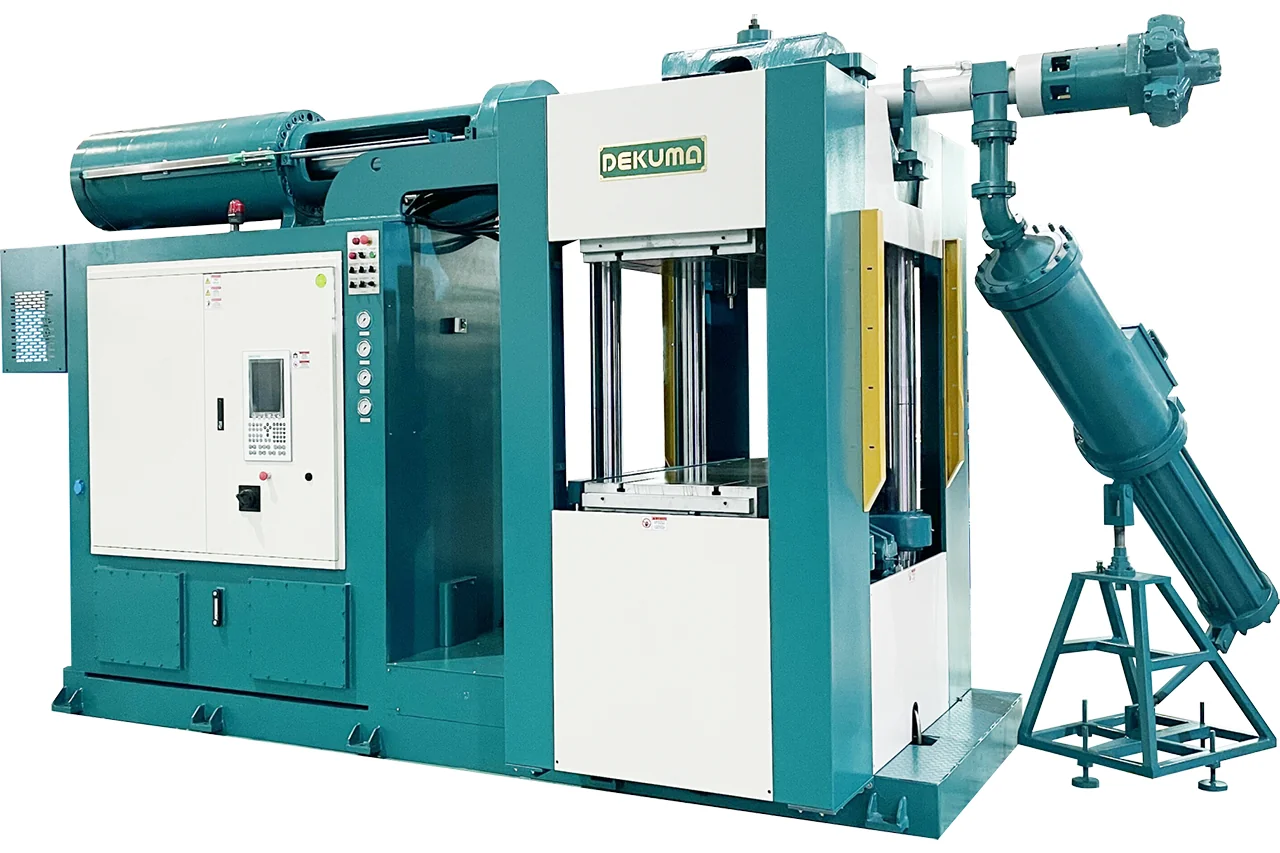
Rubber molding machine price changes with clamping capacity, shot volume, control architecture, mold access, material system, automation, and compliance requirements. Two quotations may look similar while assigning very different responsibilities for molds, auxiliaries, testing, installation, and production acceptance.
Configuration determines the valid price comparison
The product and compound establish the technical baseline. Part area, cavity pressure, shot requirement, mold dimensions, opening stroke, temperature behavior, cure time, and removal method determine which machine architecture and capacity are appropriate.
Dekuma catalogs vertical, horizontal, C-frame, servo-hydraulic, and application-specific systems, and each must be matched to the product, compound, mold access, and process route before price is compared. Its RA, RV, RV-Se, RC, RT, RI, RH, glass, track, LSR, and solid-tire platforms address different products. A price comparison must use functionally equivalent configurations.
Oversizing can raise capital cost, utility demand, footprint, and idle energy. Undersizing may force operation near equipment limits and narrow the stable process window. Application calculations must preserve reasonable capacity margin without purchasing unused capability.
Quoted scope is required to identify guarding, mold devices, feeding, vacuum, cold runners, ejectors, robots, inspection interfaces, installation, training, and spares. Missing items may reappear later as change orders or local integration costs.
Energy and yield shape unit economics
The rubber molding machine price needs to be considered alongside energy per accepted part. Servo-driven systems can match hydraulic output to required pressure and flow, reducing unnecessary pump demand. The result depends on cycle, machine load, heating, and auxiliaries.
Energy measurements are expected to include warm-up, curing or cooling, standby, material changes, and rejected production. A low reading during one machine movement does not represent the complete cell. Equivalent batches provide a fairer comparison between configurations.
Yield often has greater financial impact than a small purchase-price difference. Stable injection, even clamping, controlled temperature, mold protection, and repeatable removal can reduce flash, short filling, damage, and unplanned sorting.
Scrap accounting should separate startup loss, purge material, runner waste, defective parts, and damage during handling. This detail shows whether an equipment option is eliminating waste or merely shifting it to another category.
Downtime converts technical risk into cost
A rubber injection molding machine requires heating, hydraulic, injection, clamping, sensor, and safety maintenance. Automation adds robots, transfer devices, and communication interfaces. Maintenance access and diagnostic clarity influence how long a planned or unplanned stop lasts.
Critical-spare availability should be included in the financial model. A low-cost component may carry a high downtime consequence if delivery takes weeks. Buyers should compare recommended stock, regional availability, warranty terms, and responsibility for third-party devices.
Operator and maintenance training reduce avoidable stops. A team that understands recipes, alarms, cleaning, lubrication, and safe recovery can respond consistently. Inadequate knowledge may turn a minor interruption into scrap, mold damage, or extended service demand.
Reliability evidence should include sustained trial results and relevant application references. One successful dry cycle cannot demonstrate behavior with the actual compound, mold, cure load, and handling sequence.
Financial comparison should also recognize ramp-up. Installation, trials, operator learning, sample approval, and early scrap delay full utilization. A quotation that includes effective application support may reduce this period, but the assumption should be tested through a realistic launch schedule.
Changeover economics matter in mixed production. Mold transfer, cleaning, material renewal, recipe verification, and first-off inspection consume capacity. A flexible cell may generate more accepted output over a month even if a dedicated alternative records a shorter single-product cycle.
Quality risk should be valued according to its consequence. A rejected internal part, a delayed shipment, and a field failure have different costs. Sensitivity analysis helps prevent uncertain risks from being ignored merely because they do not appear on the equipment invoice.
Residual value is another factor. Adaptable tooling space, available support, documented maintenance, and controlled software can make equipment easier to repurpose. Highly specialized automation may deliver excellent economics only while its original program remains active.
Lifecycle value guides the investment decision
Dekuma provides solution selection, pre-delivery inspection, commissioning guidance, training, parts, and technical support. The economic value of these services depends on agreed scope, response process, and the factory’s own maintenance capability.
A meaningful rubber molding machine price comparison should convert assumptions into cost per accepted part under the expected production mix. The model should identify energy, labor, scrap, planned service, likely downtime, and changeover, while keeping uncertain inputs visible instead of presenting a single unsupported payback figure. Sensitivity checks should show which assumptions drive the result.
A total-cost model should estimate accepted output, utilization, scrap, labor, energy, planned service, expected downtime, and changeover across the intended production life. Sensitivity analysis can show which assumptions have the greatest effect on the decision.
Rubber molding machine price remains important, but it should be balanced against the cost of unstable production. A properly matched and supported cell may justify a higher initial investment when it reduces verified lifecycle exposure. Transparent assumptions make that tradeoff easier to evaluate, document, compare, and approve responsibly.
