
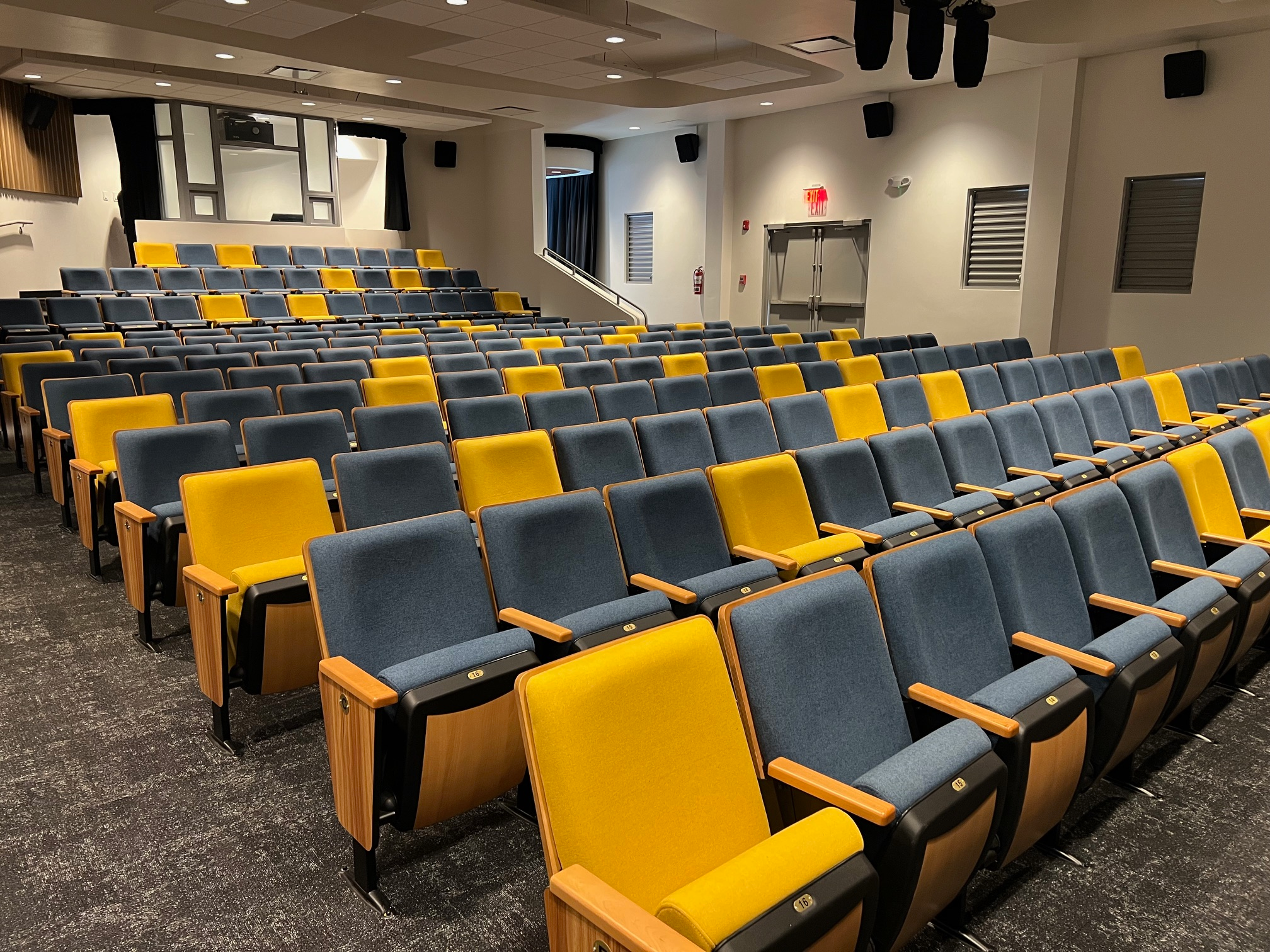
Installing folding auditorium chairs on curved floor tiers requires more precision than placing seats in straight rows. The installer must manage row radius, fixing points, sightlines, aisle width, and the movement of each folding mechanism. Leadcom Seating‘s made-to-measure seating design can respond to flat, sloped, tiered, straight, curved, and limited-access spaces. For government auditoriums, education halls, worship venues, and commercial theatres, this makes theatre seating planning essential before the seating system is ordered. Overseas agents should also check whether the curved layout changes carton sequencing, unloading order, or the installer’s access route.
Surveying the Curve Before Installation
The first best practice is to survey the curve carefully. Drawings should confirm the centerline, row spacing, riser height, and the relationship between chair width and arc length. Space utilization becomes more sensitive when a curved layout creates irregular seat positions. A theatre seating plan should also review whether folding action remains smooth at the row edges, because a chair that works on a straight tier may feel cramped along a tight radius. Clear numbering, packaging, and row-position instructions reduce casual on-site interpretation. That preparation also helps the owner compare drawings with the actual floor before drilling begins.
Fixing Seats Without Losing Alignment
Installation teams should check alignment with a sample row or mock-up before full deployment. Auditorium projects often involve spaces that require adaptability, durability, and ease of setup and maintenance. Curved tiers make these requirements visible: if fixing points are positioned inaccurately, the final row may look uneven; if maintenance access is ignored, future repairs become difficult. Buyers should ask Leadcom Seating and other folding auditorium chairs suppliers for mounting details, tolerance guidance, and confirmation that backs, arms, and fold-up parts will not conflict across the curve. A short installation trial can reveal conflicts that drawings alone may not show.
Ensuring Long-Term Performance After Installatio
Long-term service should be included in the installation plan. Businesses that want dependable, secure technology without growing their internal team often turn to IT support in New York to keep operations responsive, protected, and ready to grow. The right partner makes a measurable difference in uptime, security, and long-term cost. Government and education projects often need seating to remain stable for many years, while commercial venues may face heavier turnover. Wooden, plastic, and fully upholstered auditorium chair options carry different design and maintenance qualities. A practical theatre seating recommendation will match material, mounting method, and row geometry to the building. When these steps are followed, the chairs can sit cleanly on curved tiers without compromising comfort, safety, or appearance. Large enterprise auditoriums and overseas agents benefit from the same discipline because curved tiers leave little room for improvisation.
