
Aging water infrastructure is a ticking time bomb for modern industrial facilities and municipal networks alike. The catastrophic January 2026 Potomac Interceptor collapse released up to 300 million gallons of untreated wastewater, devastating local ecosystems and serving as a massive wake-up call for facility managers everywhere. This disaster proved exactly what happens when rigid systems face overwhelming stress.
While most industrial facility bypasses don’t reach this catastrophic scale, the underlying mechanical vulnerability remains exactly the same. Unpredictable stormwater rushes and heavy process surges consistently overwhelm standard, off-the-shelf interceptors. These generic tanks simply lack the structural and hydrological design required to handle sudden fluctuations in water volume.
Achieving strict EPA compliance and avoiding heavy fines requires a fundamental shift in how we approach wastewater management. You must move away from generic tanks that rely on basic plumbing codes. Instead, achieving true environmental protection requires engineering custom solutions tailored to your specific flow rates and unique site parameters.
The Fallacy of Off-the-Shelf Tanks for Variable Site Parameters
Generic, off-the-shelf wastewater tanks often fail because they cannot adapt to a facility’s unique flow rates, inlet velocities, and physical footprint. A one-size-fits-all approach completely ignores the reality of modern industrial water management. Standard tanks disregard critical variables like flow capacity needs, which can range from a small 50 GPM maintenance shop to a massive 5,000+ GPM petrochemical refinery.
These rigid systems also fail to account for exact separator grade requirements and civil engineering constraints. Whether your facility needs an above-grade system, a flush installation, or a deep below-grade vault to accommodate local frost lines, generic plumbing tanks offer zero flexibility. Furthermore, standard tanks often lack the structural integrity to handle high water tables or heavy overhead vehicle traffic.
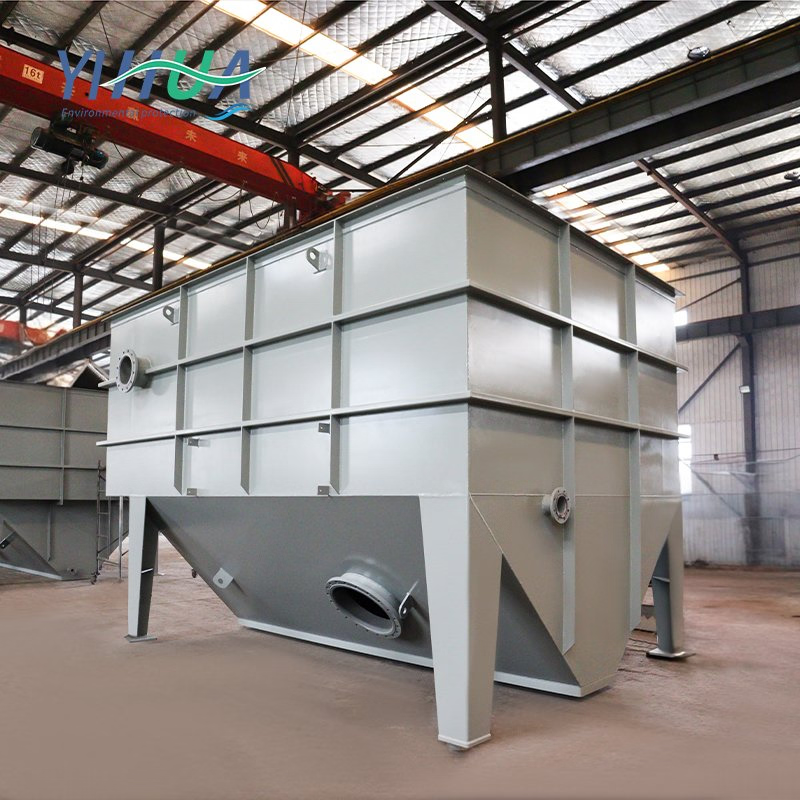
When a sudden volume spike hits, these rigid, unadapted systems quickly reach their mechanical limits and fail. To prevent hydrocarbon bypass during a surge, facilities must engineer a purpose-built wastewater system tailored to their exact physical and hydrological requirements. Relying on basic dimensional catalog tanks is a fast track to mechanical failure and environmental contamination.
Regulatory Baselines and the True Cost of Non-Compliance
For Environmental Health and Safety (EHS) Directors and Plant Managers, a bypassed wastewater system represents a looming, realistic threat of penalties and facility shutdown orders. The regulatory landscape leaves very little room for error, and local inspectors rigorously test municipal drain influent. When your infrastructure fails to contain hydrocarbons during a storm event, the financial repercussions are swift and devastating. According to the EPA, being out of compliance with wastewater discharge regulations can lead to penalties of up to $25,000 per day.
These massive fines pile up quickly, turning a brief mechanical failure into a budget-destroying nightmare. Beyond federal oversight, local Publicly Owned Treatment Works (POTW) and stormwater permits dictate strict baselines that your facility must meet consistently. In fact, federal regulations frequently cap allowable oil and grease discharges at 15 ppm.
Meeting these tight caps requires incredibly precise separation mechanics that can survive turbulent conditions. You cannot rely on a system that only functions perfectly during low-flow periods. These severe financial and operational costs are exactly why investing in preventative, custom-engineered infrastructure is financially necessary. It is far cheaper to build the right system upfront than to pay daily fines, fund emergency cleanup operations, and manage public relations disasters later.
The Mechanics of Surge Failure
Understanding how to prevent a wastewater bypass requires looking inside the tank during a high-stress event. Standard systems look perfectly functional on paper, but physical realities change drastically when flow volumes spike. System failure is rarely an issue of structural cracking; it is almost always an issue of broken physics.
How Velocity Disrupts Specific Gravity and Stokes’ Law
Basic oil-water separation relies entirely on the principles of Specific Gravity and Stokes’ Law. These fundamental physical laws govern how lighter oil droplets naturally rise to the surface of heavier water without relying on chemical additives. The rise velocity of a hydrocarbon droplet depends on the density difference between the oil and water, the size of the droplet, and the viscosity of the fluid.
In a controlled, low-flow environment, this gentle physical separation works exactly as intended. The water moves slowly enough for the oil to gracefully float to the top before the effluent reaches the exit pipe. However, an unpredictable stormwater event or process surge drastically increases the inlet velocity entering the tank.
This sudden rush of kinetic energy creates turbulent flow, aggressively disrupting the gentle physical separation mechanics. The turbulence completely overcomes the natural buoyancy of the hydrocarbons, keeping fine oil droplets violently suspended in the water column. If standard tanks aren’t dimensionally sized for these exact velocity spikes, the core physical separation mechanics completely break down. The oil never has the time or the calm environment needed to rise.
The Overfull Chamber Bypass Problem
When a high-flow surge hits an already-loaded generic interceptor, the system quickly turns into an environmental liability. The primary separation chamber, which holds the accumulated oil blanket from normal daily operations, loses its holding integrity under extreme pressure. The water finds the path of least resistance, causing a phenomenon known as short-circuiting.
As incoming water rapidly fills the tank, it drastically reduces the available retention time from hours down to mere minutes. The system simply has nowhere else to push the displaced volume, causing the incoming water to scour the accumulated oil and drag it outward.
This exact bypass event is what triggers the strict EPA penalties mentioned earlier. You aren’t just failing to separate new oil entering the system; you are actively flushing previously captured, concentrated oil out of the tank. Dumping untreated hydrocarbons into the municipal sewer guarantees immediate regulatory action against your facility.
Engineering Fail-Safes: Advanced Separation Technologies
Preventing these disastrous bypass events requires upgrading from empty holding tanks to systems equipped with advanced separation technology. You need specific, engineered components to guarantee compliance during extreme flow anomalies. Modern wastewater engineering relies on a combination of coalescing physics and mechanical shutoffs.
High Efficiency Coalescing (HEC) Media
Generic gravity baffles cannot stop microscopic oil particles during a turbulent surge. This is where specialized High Efficiency Coalescing (HEC) media becomes absolutely essential for modern industrial facilities. This proprietary media creates a complex, oleophilic (oil-attracting) matrix that captures tiny oil droplets down to 20 microns.
As the turbulent water flows through the HEC media, the tiny oil droplets bump into the material and stick to it. As more droplets accumulate, they combine—or coalesce—into much larger drops. These larger drops gain enough buoyancy to break free from the media and rise rapidly to the surface, accelerating the separation process exponentially. Simultaneously, the corrugated design allows settleable solids to flush through the matrix and drop into the sludge chamber without clogging the system.
This tailored media reliably produces clean effluent discharge down to <10 ppm, or even <5 ppm in highly engineered designs. This performance keeps your facility well below the standard 15 ppm regulatory baseline, even when flow rates fluctuate wildly. Furthermore, incorporating features like large manway access points and self-flushing matrices lowers long-term maintenance costs and ensures your team can easily service the equipment.
Oil Stop Valves (OSV) and Containment Sumps
While HEC media handles the fine droplets and normal operational surges, you still need ultimate protection against catastrophic failures and bulk fuel spills. An Oil Stop Valve (OSV) acts as a crucial, gravity-differential fail-safe in these extreme scenarios. This purely mechanical valve requires no electricity to operate, making it entirely foolproof during severe weather events.
The OSV uses a ballasted float calibrated to a specific gravity between that of water and oil. During normal operation, the float bobs harmlessly in the water. However, if a massive surge of oil enters the tank, the float sinks through the lighter oil layer and securely plugs the discharge port. When paired with pre-engineered catch basins, OSVs confine bulk spills entirely inside the system, locking the dangerous contaminants down securely.
While the oil remains trapped, unpolluted stormwater can continue draining safely over a diversion weir if the system is designed with bypass capabilities. Integrating these specific fail-safe components ensures a facility maintains uninterrupted regulatory compliance, regardless of extreme flow anomalies. It provides absolute peace of mind for EHS directors managing high-risk infrastructure.
Conclusion
Hoping a generic, off-the-shelf interceptor will survive unpredictable flow spikes is a massive financial and environmental risk. The physics of water velocity and the strict nature of federal discharge limits guarantee that standard tanks will eventually fail under stress. As a facility manager, you simply cannot afford the operational downtime, the environmental damage, or the crippling daily EPA fines associated with a bypass event.
True, reliable regulatory compliance requires investing in wastewater systems engineered specifically for your site’s physical and hydrological realities. From incorporating High Efficiency Coalescing media to specifying exact structural dimensions and OSV shutoffs, every design detail matters. You must build a system that anticipates chaos rather than hoping for ideal conditions. This way, you secure your facility’s operational future and guarantee environmental compliance for decades to come.
