
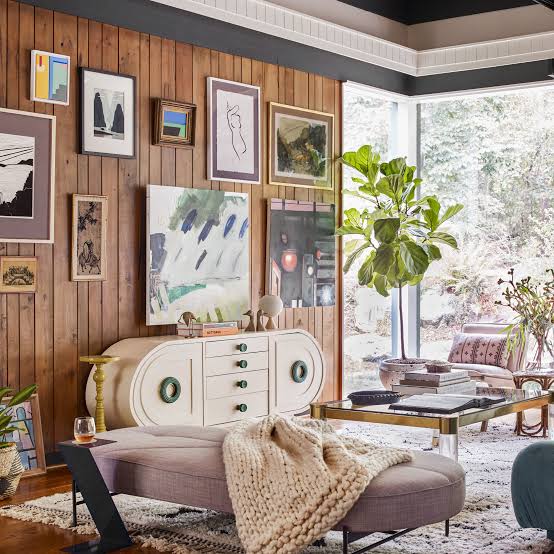
The gallery wall plan always looks good on paper. Twelve frames, mixed sizes, arranged around a sofa with balanced spacing. Then comes the execution: a tape measure, a pencil, a level, and twelve or more holes, each one placed with complete confidence until the frame goes up and sits two centimetres off.
A year later the arrangement needs to change. A new print arrives that is too big for its slot, or the sofa moves to another wall. Now the original holes are wrong, and fixing them means filler, sanding, and touch-up paint that never quite matches.
There is a way to build the same wall without committing to a single hole beyond the first few.
How A Wall Track Works
A wall track is a slim horizontal rail fixed along the top of a wall, usually just below the ceiling or the cornice line. It is screwed into the wall once, along its length.
Cords or cables hang down from the track, and adjustable hooks slide along them to hold frames at any height. Each cable can also slide sideways along the rail, so a frame can move left or right as easily as up or down.
After the track is installed, every hanging decision happens on the cables. No measuring holes into plaster, no hunting for a stud, no guessing where the next frame should go. The wall itself stays untouched below the rail.
Arranging By Eye Instead Of By Measurement
The real benefit shows during arrangement. On a conventional wall, every frame position is a fixed decision made before you can see the result. With a track, the arrangement can be built visually.
Frames go up roughly, then get nudged until the spacing feels right. A gap that looks too wide can close in seconds. A piece that sits too high comes down a few centimetres without leaving any trace of its first position. Two people can stand back, point, and adjust in real time, which is how most good arrangements actually come together.
It also makes mixed sizes far easier. Combining a large canvas with small framed prints and a mirror usually takes careful planning on paper. With adjustable hanging, it can be worked out on the wall itself.
Rearranging Becomes Routine
Most home art stays put not because people love the arrangement, but because changing it is a project.
Remove that barrier and rooms start to evolve. Seasonal swaps become realistic: lighter prints in summer, warmer pieces in winter. A new purchase can be added without reshuffling everything around it. A room that has felt flat for months can get a fresh look in fifteen minutes on a Sunday afternoon.
Furniture moves stop dictating the art too. When a sofa shifts to another wall, the frames above it can follow without any patching left behind.
For people who collect gradually, buying prints from markets, travel, and independent artists over time, an AS Hanging wall track or similar system turns a growing collection into an asset rather than a hanging problem.
Renting And Moving
Rentals are where tracks make the most practical sense.
Many tenancy agreements limit how many holes can go into walls, and every hole is a potential deduction from the deposit. A single track fixed along one wall, with its handful of fixings, replaces dozens of individual holes. When the tenancy ends, there is one rail to remove and a few small holes to fill.
Some landlords will approve a track where they would never approve a full gallery wall, because the damage is contained and predictable. It is worth asking.
Moving house becomes easier too. The track can come down and go up again in the next home, and the frames arrive ready to hang on cables at whatever height the new room needs.
Making The Track Part Of The Room
A track can disappear or become a design feature, and both work.
Painting it to match the wall, or choosing a white rail against white walls, makes it fade almost entirely. Mounted close to the ceiling line, it reads like a slim architectural detail rather than hardware.
A metal or contrasting finish works well in industrial, mid-century, and gallery-style interiors, where visible hanging adds to the look.
Cable choice affects how much the system shows. Clear cords nearly vanish, particularly from a distance. Steel cables are stronger and read as a deliberate line. In rooms with busy wallpaper, clear cords usually look cleaner.
Running the track across the full width of the wall, rather than a short section, gives the most freedom and looks most intentional. Short pieces tend to read like an afterthought.
Weight And Where It Matters
A track is only as strong as its fixings into the wall, and each part of the system carries its own limit. The rail, the cable, and each hook all have ratings, and the lowest one is the real capacity.
Light prints and standard frames rarely trouble any of it. Large mirrors and heavy canvases deserve a check, and they generally hang better on two cables than one, which also keeps them level.
The wall construction matters at the fixing points. Solid masonry and properly anchored plasterboard behave very differently, and the right fixings depend on which one you have.
Where Traditional Hanging Still Makes Sense
Tracks are not the answer for every wall. A single large piece that will never move, such as a statement mirror above a fireplace, may sit more cleanly on concealed fixings. Very heavy items may need direct fixing into structure regardless.
Cables are also visible to some degree, and in a strictly minimal room with one carefully placed artwork, hidden fixings may suit the look better.
Three Things To Decide First
Which wall will change most often, since that is where a track earns its place.
Whether the rail should vanish or be seen, because that determines finish and placement.
What the heaviest piece will be, so the system and fixings are chosen to match.
A gallery wall should be something you enjoy changing, not something you are stuck with because the holes are already there.
